Winter Soaring and Wave Flying (1947)
In February 1947, Cowboy and some club mates from Aarhus defied the winter cold and achieved three 5- hour duration flights in a Grunau Baby above the 39-metre-high slope at Bogensholm at the foot of the Mols Hills overlooking Ebeltoft Bay. Later that year, at Whitsun, Cowboy became acquainted with wave flying from Steinsfjorden in Norway. In June, Cowboy, Harboe, and Møller-Madsen, and in August Jespersen, Klarskov, and Wetlesen, spent time at gliding schools in Czechoslovakia, where they had the opportunity to fly Kranich and Weihe gliders in the local wave conditions.
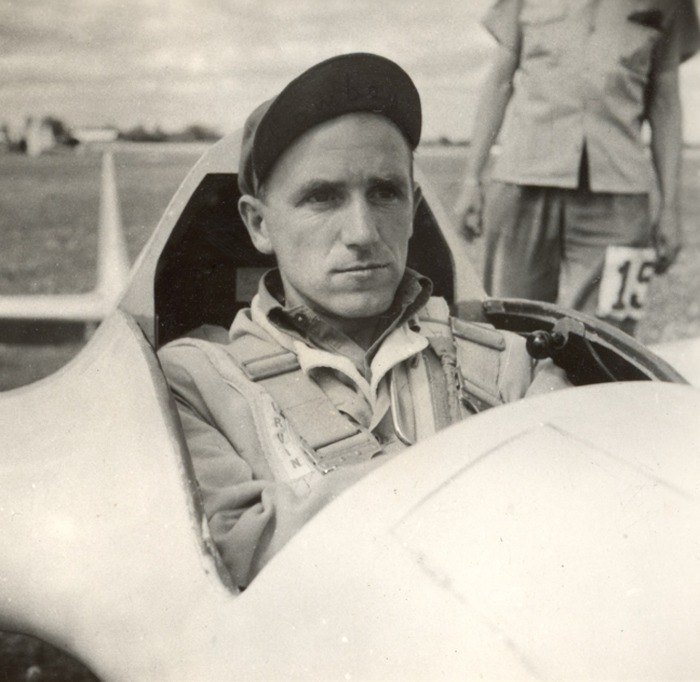
Cowboy served as an instructor at the gliding association’s summer camp at Vandel Air Base, held during an exceptionally sunny August, which marked a major breakthrough for cross-country flying in Denmark. With great confidence and charisma, Cowboy showed his comrades how it should be done. Several pilots set out on the approximately 55 km cross-country flight from Vandel to Esbjerg and landed at Esbjerg airfield.
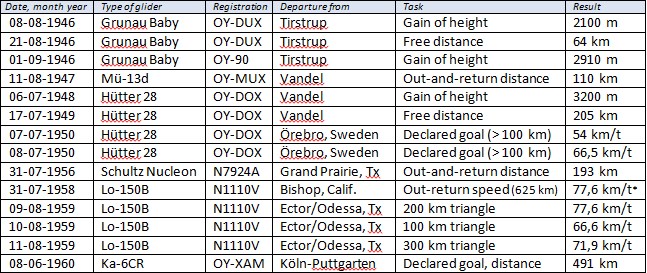
However, Cowboy - flying a Mü-13d (OY-MUX) on 11 August 1947 - outdid them all by turning over Esbjerg and returning to Vandel, thereby proclaiming Denmark’s first out-and-return flight of 110 km and setting a Danish record.
The Hütter H-28 – A Perfect Match (1948–1949)
On 6 February 1948, the Aarhus pilot Gunnar Juul Thomsen purchased the small Hütter H-28 glider from Carl Johansen, who had built it himself between 1937 and 1942 but had only flown it a couple of times. With this acquisition, Juul Thomsen believed that he himself and club mates Wetlesen, Klarskov, and Cowboy were now well equipped to realize the previously untapped potential they believed the aircraft possessed. At Easter, members of Aarhus Gliding Club and the Polytechnic Flying Group went on an expedition to Steinsfjorden in Norway, where they tested both ridge and wave flying in the H-28, reaching altitudes of up to 3,600 metres.
Back at Vandel Air Force Base, Cowboy reclaimed the gain-of-height record on 6 July with a climb of 3,200 metres in the H-28, a record a club mate had dared to take from him.
In 1949, Cowboy was again at Vandel, serving as chief gliding instructor during the gliding association’s instructor course and summer camp. On 17 August, he flew the H-28 from Vandel to Herlev in 5½ hours, covering a distance of 205 km and setting a new Danish record. To fit into the cockpit, he flew the entire flight wearing only socks, but after landing he put his wooden clogs back on - much to the astonishment of the surrounding Copenhageners, for whom such footwear was a rare sight.
In early May, Cowboy, Wetlesen, and Klarskov were once again on the road with the H-28, this time travelling to St. Cyr in France. The journey went via the Netherlands, where the small group visited the Terlet gliding centre.
World Championship Debut in Örebro (1950)
From 3–16 July 1950, Cowboy, flying the H-28, and Karlheinz A. Rasmussen, flying an Fi-1, became the first Danes to participate in the World Championships, held in Örebro, Sweden. Cowboy was assisted by his brother Ebbe, Klarskov, and cinema owner Ejvind Nielsen. Despite inferior equipment, Cowboy finished 16th and Rasmussen 18th among 29 competitors. During the championships, both completed a 265 km distance flight with landing at Torslanda near Gothenburg. As Rasmussen arrived later, Cowboy was awarded a new Danish record for his flight.
During the championships, on 6 July, Cowboy set a Danish record for a 100 km goal flight from Örebro to Torslanda/Gothenburg (265 km) at an average speed of 54 km/h in the Hütter 28. The following day, 7 July,
he set yet another Danish record with the same aircraft and in the same discipline on the route Örebro– Sävare (162 km), increasing the average speed to 66.5 km/h.
Danish Champion and Family Life (1952–1954)
At the 1952 World Championships in Spain, Denmark was represented by Harald and his younger brother Ebbe flying a Kranich provided by the Spanish organizers. Karlheinz A. Rasmussen and Tage Slottboe also flew a Kranich, while the 1951 Danish champion Aksel Feddersen flew a Spanish Weihe. In the two-seater class, Rasmussen placed 8th and Cowboy 12th out of 17 competitors, while Feddersen finished 22nd out of 39.
Finally, at the Danish Championships in 1953, Cowboy succeeded in reaching the top and winning the title of Danish Champion. He claimed victory in the gliding association’s newly acquired EoN Olympia, OY-FUX, in a field of nine competitors. The company “Dansk Aero” had delivered the aircraft just in time before the competition after an extensive rebuild. On top of this, Cowboy received The Royal Danish Aeroclub magazine “FLYV’s” honorary award of 500 kroner for his many years of contribution to Danish gliding. This also marked the end of an era in which flying had taken precedence over everything else. Cowboy had meanwhile married Alice and started a family, and his work now absorbed more of his time than before.
Gliding was largely limited to his participation in competitions.
For example, at the 1954 World Championships in Camphill, England, Cowboy once again relied on the venerable EoN Olympia, OY-FUX. In terms of results, he was beaten by compatriot Aksel Feddersen, who finished 11th, also flying an Olympia, while Cowboy placed 18th out of 34 competitors.
In the Wermuth Jensen family there were seven siblings, six of whom - all sons - were involved in gliding. Around 1950, Cowboy had been employed by the Aarhus businessman G.A.L. Thorsen, with whom he later developed the method and tooling to press a steel sink in a single operation.
America Calling – The Jensen Flying Sink (1955–1962)
In 1955, together with his brothers Svend and Kresten, he moved to America, where they established “The Jensen-Thorsen Corporation” in Illinois and began large-scale production of steel sinks. The company was very successful and eventually employed a hundred people. After a few years in the USA, Cowboy acquired a Lo-150B (N1110V) and named it “The Jensen Flying Sink.”
As early as 1956, Cowboy borrowed the experimental aircraft “Nucleon” (N7924A) from its owner, Arthur
B. Schultz, and on 31 July flew a new Danish out-and-return distance record of 193 km from Grand Prairie, Texas, via Mineral Wells and back. Schultz was a flight engineer who had designed and built the Nucleon himself in 1954.
The Nucleon had a 14-metre wingspan, a NACA laminar profile, and classic wooden main spars. The wings were braced with struts down to the fabric-covered steel-tube fuselage. As a completely new feature, the wings incorporated shaped Styrofoam with a fibreglass skin, providing good surface accuracy. Nevertheless, even though the flaps and ailerons were interconnected and the all-up weight was only 243 kg, the glide ratio was a modest 22 at 75 km/h. Art Schultz competed in the American Championships that same year with the Nucleon and, against all odds, achieved a respectable 16th place out of 46 competitors. On 7 August 1956, Cowboy succeeded in completing a Golden C task in the form of a 314 km free distance flight from Grand Prairie to Tulake, also in the Nucleon.
Two years later, on 31 July 1958, during the American Championships, Cowboy used his new Lo-150 for a highly spectacular 625 km out-and-return flight from Bishop, California, to El Mirage, Nevada, and back. The flight was carried out in company with his friend Dick Schreder, who flew his own design, the HP-8. Cowboy completed the task in 8 hours and 5 minutes, corresponding to an average speed of 77.6 km/h, while Schreder was 20 minutes faster. Both flights exceeded the existing world record but remained unofficial due to an inaccurately placed start line. In Denmark, however, the record counted in several existing categories at the time, namely speed to declared goal over 100, 200, 300, 400, and over 500 km.
In 1959, Cowboy set no fewer than three Danish records with his Lo-150 from Ector County Airfield in Odessa, Texas, over triangular courses of 100, 200, and 300 km respectively:
– On 9 August, he flew a 200 km triangle at 77.6 km/h, breaking Niels Sejstrup’s previous record.
– On 10 August, he flew a 100 km triangle at 66.6 km/h, breaking Aage Dyhr Thomsen’s record.
– On 11 August, he became the first Dane to fly a 300 km triangle. Start and finish were at Odessa, with turnpoints at Eunice and Lamesa. The average speed was 71.9 km/h.
Back in Denmark, he participated in the 1959 Danish Championships at Vandel Air Base with a German- registered Lo-150 borrowed from Wolf Hirth. In return, Cowboy had lent his own Lo-150 to the German pilot Peter Riedel, who flew it in the American Championships.
At the Danish Championships, after two day victories out of a total of seven valid days, Cowboy had to settle for an overall 5th place - coincidentally the same number displayed on the tail of the aircraft he flew. There were 17 competitors.
In 1960, the World Championships were held in Cologne, Germany, where Cowboy was forced to compete in the open class with the standard-class Ka-6CR (OY-XAM) and finished in 7th place. Niels Sejstrup placed 4th in the standard class, also flying a Ka-6CR. Jørgen Friis flew a Mucha. During the competition, on 8 June, Cowboy set yet another Danish record with a distance-to-goal flight of 491 km from Cologne to Puttgarten on the island of Fehmarn.
1962 became Cowboy’s greatest year when, on 15 April, he flew his Lo-150 in a straight-line distance of no less than 435 miles (692 km) from Naperville, Illinois, to Hohenwald, Tennessee. This was the longest distance flown in the USA that year and earned him the coveted Lewin B. Barringer Trophy.